
When you flip a light switch, turn on the central air conditioning, or plug in an electric vehicle, you expect continuous, invisible power. However, beneath the surface of many Greensboro residences lies an electrical skeleton designed for a completely different era.
If your home was built or last wired prior to the modern digital explosion, your electrical service panel, the central nervous system of your property’s power, is likely running at or near its thermal limits. Upgrading your electrical panel to a 200-amp (or a 400-amp) service is no longer just a luxury renovation; it is a foundational safety requirement for the modern household.
Here is a clinical breakdown of how to recognize the symptoms of panel stress, why 200-amp panels are the new standard, and what to expect during a professional service upgrade.
Recognizing the Symptoms of Panel Stress
An electrical panel does not fail without warning. Like any complex system, it exhibits distinct symptoms when its continuous thermal load capacity is exceeded. If you are noticing any of the following occurrences in your Greensboro home, your power grid is signaling a need for intervention:
- Nuisance Breaker Tripping
- Flickering or Dimming Overhead Lights
- Thermal Discomfort at the Panel Box
- Audible Buzzing or Micro-Arcing
- Obsolete Fuse Boxes or Federal Pacific/Zinsco hardware
Diagnostic Note: A single tripping breaker might simply point to an overloaded branch circuit. However, widespread flickering or multi-circuit breaker drops indicate an overloaded main bus bar or an undersized main service entrance.
Why a 200-Amp Upgrade is the Modern Standard
For decades, 100-amp panels were the industry benchmark. However, 100-amp panels were sized for homes that ran a refrigerator, a television, and incandescent bulbs. Today’s living spaces feature high-demand electrical loads that quickly exceed legacy capacity.
Many homes have multi-zone heat pumps and variable-speed compressors that require significant power to start and continuous amperage to maintain functionality. Electric vehicles consume around 30% of a 200-amp panel’s capacity. Standby generators also require high-capacity panels to remain in operation.
When you upgrade electrical panel infrastructure, you aren’t just adding breakers; you are replacing the main service entrance cables, weatherhead, utility meter base, and internal bus bars to ensure clean, unrestricted current delivery.
The Surgical Process: How a Professional Upgrade Works
Executing a code-compliant electrical panel upgrade involves far more than simply swapping out a box. It requires precise technical coordination between licensed specialists, municipal inspectors, and utility providers like Duke Energy. Some of the steps involved are:
- A Property Evaluation: Every project begins with a comprehensive $69 Onsite Property Evaluation. A specialist inspects your home’s electrical skeleton, calculates total load requirements, and presents clear, upfront options directly on a tablet.
- Diagnostic Triage (If Hidden Faults Exist): If your home is experiencing complex “ghost” faults or hidden wiring breakdown behind drywall, specialized $300 to $650 Diagnostic Triage testing is authorized to isolate circuit failures before new equipment is energized.
- Permitting & Utility Scheduling: Complete administrative management, pulling Guilford County permits and scheduling meter disconnections with Duke Energy.
- Surgical Execution: The physical installation involves mounting the high-capacity breaker enclosure, upgrading meter bases, running new service entrance conductors, and bonding dual copper grounding electrodes.
- Restoration & Verification: The utility reconnects the power drop, municipal inspectors approve the work, and your home’s electrical health is fully restored.
Local Considerations for Greensboro & The Triad
Homes across Greensboro, Oak Ridge, Summerfield, and the surrounding Asheboro corridors face specific localized stresses. Summer thunderstorm cells bring intense voltage surges that strain aging panels, while rapid population expansion puts continuous demand on utility lines.
Ensuring your panel has whole-home surge protection and clean capacity guarantees that your family, high-end electronics, and major property investments remain completely safe year-round.
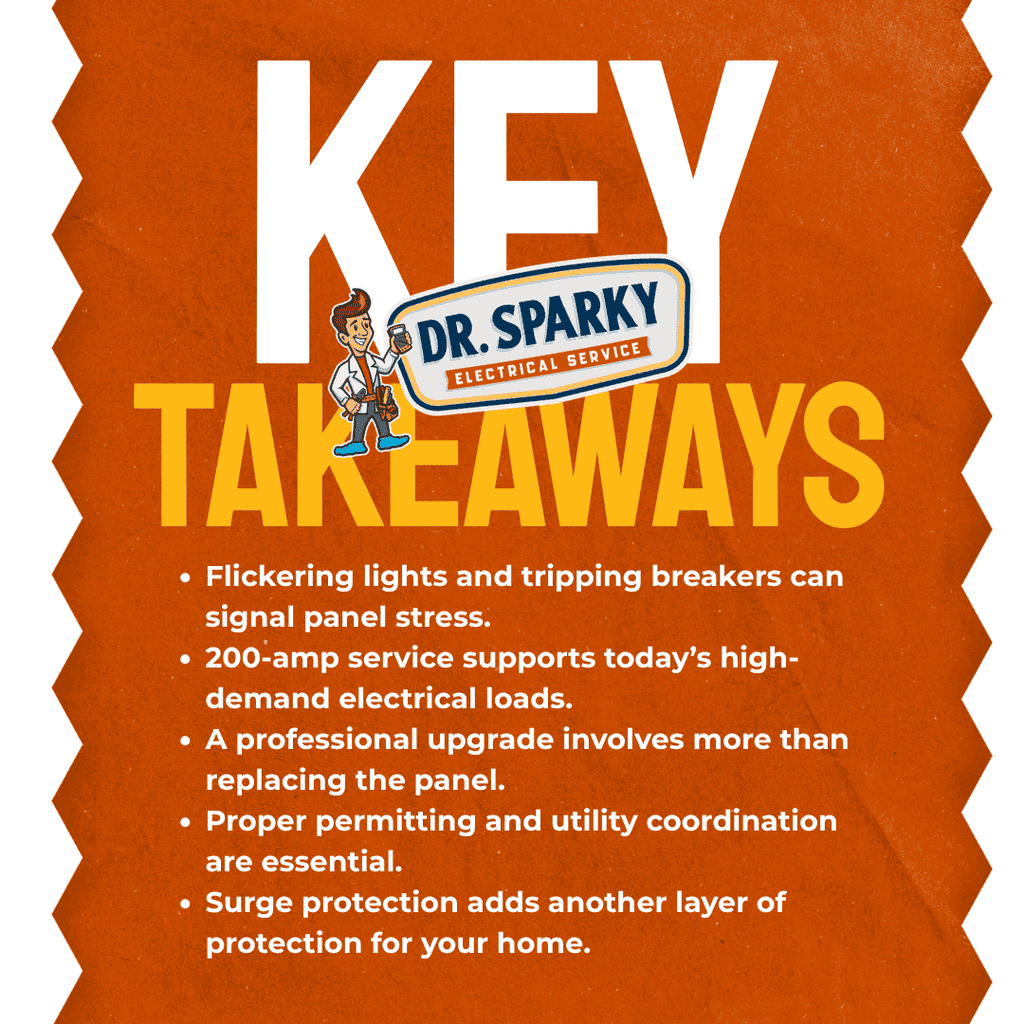
Frequently Asked Questions: Upgrading Your Electrical Panel
1. How do I know if my electrical panel is currently overloaded? Like any system under stress, your electrical panel will exhibit specific symptoms before a complete failure. Look for nuisance breaker tripping, lights that flicker or dim when major appliances turn on, audible buzzing, or a metal panel box that feels warm to the touch. If you have obsolete equipment like a Federal Pacific or Zinsco box, your home requires immediate intervention regardless of current symptoms.
2. Is a 100-amp panel enough for my home, or do I really need 200 amps? While 100 amps were the industry standard decades ago, they are no longer sufficient for modern living. Today’s homes run multi-zone HVAC systems, electric vehicles (which alone consume roughly 30% of a 200-amp panel’s capacity), and standby generators. A 200-amp (or 400-amp) panel provides the foundational capacity required to run your home safely without exceeding thermal limits.
3. What is the difference between the $69 evaluation and the $300-$650 diagnostic fee? Our $69 Onsite Property Evaluation covers the dispatch and a comprehensive visual inspection of your home’s electrical skeleton. During this evaluation, we assess your load requirements and present you with clear, upfront options for your panel upgrade. The $300 to $650 Diagnostic Triage fee is applied only if your home is experiencing complex “ghost” faults, hidden circuit failures, or wiring breakdowns that require specialized testing to isolate before we can safely proceed with a cure.
4. Can I just add a few more breakers instead of upgrading the entire panel? No. Upgrading your electrical infrastructure is not as simple as making room for more switches. When a panel is maxed out, the issue lies in the main bus bar and the main service entrance cables from the utility. A professional upgrade ensures the entire system, including the meter base and grounding components, is sized correctly to deliver clean, unrestricted current to those breakers.
5. Why are homes in the Triad area specifically at risk for panel stress? Homes in Greensboro, Oak Ridge, Summerfield, and Asheboro deal with severe summer thunderstorm cells that introduce intense voltage surges to residential power grids. Furthermore, rapid population and industrial expansion (like the new Toyota Battery Plant) put continuous demand on aging utility lines. A modernized panel paired with whole-home surge protection shields your high-end electronics and appliances from these localized environmental stresses.